
A small note on the context of the research: the paper brings together two strands of my work. The technical and performative foundations were developed at CREW, particularly through the Tools for Timon project and the EXP framework. The research itself was conducted as part of my artistic research project One To(o) Many at the Royal Academy of Fine Arts Antwerp, Intermatter group, where I was able to investigate distributed embodiment more fundamentally, outside of production constraints. I have more results which haven’t been published yet.
I was invited to contribute to HCI by a scholar working in the field. It was an interesting challenge to translate my artistic research into a different academic context. I'm a strong believer in practice-driven research, where building things, experimenting and demonstrating them are not simply ways of illustrating research findings, but ways of producing knowledge.
I think this is becoming increasingly important at a time when AI can generate plausible academic prose without necessarily producing new knowledge. A working prototype or a live demonstration makes the research tangible. It exposes things that are difficult to anticipate or fully articulate in writing, especially when dealing with embodied experiences. Of course, writing remains important for reflection and sharing knowledge, but I believe the work itself should carry a substantial part of the argument.
BIO
Isjtar Vandebroeck
Isjtar Vandebroeck is a Brussels-based media artist, composer and artistic researcher, and Artist and Research Lead at CREW. He develops experimental XR performances that explore the relationship between human bodies and digital systems. His practice is grounded in deep expertise in computer graphics, real-time systems and immersive technologies, treating their development as an integral part of artistic creation. In 2025–2026, he conducted One To(o) Many at the Royal Academy of Fine Arts Antwerp, investigating distributed embodiment and agency in XR.
Wieke van Rosmalen
Wieke van Rosmalen is a Dutch performer, theatre maker and musician who graduated from Toneelacademie Maastricht in 2019. Her work combines physical performance with music and technological experimentation, often taking a conceptual and playful approach. Alongside her independent productions, she has collaborated with CREW since 2022, performing in Delirious Departures, Anxious Arrivals and Tremens. Her practical exploration of multi-avatar performance contributed directly to the research on distributed embodiment.
Eric Joris
Eric Joris is a Belgian artist, director and founder of CREW, a pioneering collective working at the intersection of performance, art and technology. Since the early 2000s, he has developed immersive performances in which virtual reality is grounded in physical and sensory experience. His work has been presented internationally at major festivals and cultural institutions.
- Can you sum up the main findings of the paper on identity, agency and presence in the settings you researched?
One of the main findings is that identity, agency and presence don't necessarily have to be tied to one person controlling one virtual body.
When a performer controls several bodies, identity becomes something that is performed across them. Agency changes too, the performer has to divide their attention between different bodies, some of which continue acting independently. In a many-to-one situation, where several people influence the same body, things become even more complicated. Who owns that body? Who gets to decide what it does? The answers differ depending on whether you're looking at a shared screen or experiencing the body from inside a VR headset, or a hybrid set-up.
Sense of immersion doesn't simply disappear when embodiment becomes unstable. This tracks with CREW’s previous assessment that immersion exists when there is friction between realities. People tend to think of immersion as something that should be seamless, but moments of uncertainty or friction can actually make people more aware of their presence in the virtual world. Then again, especially in VR, it can also completely fall apart very easily, making it confusing and frustrating, so you have to be careful.
- What was your motivation to do research in this direction? The set-up or the performance about Timon?
The motivation actually goes back further than Tools for Timon. In earlier CREW productions, particularly Delirious Departures, I was already exploring ways to break the conventional relationship between one performer and one avatar.
With Tools for Timon, we finally had the technical means to take this much further. We developed a system in which a performer could record their movements, create multiple versions of themselves, manipulate them and move their live presence from one body to another.
But this also raised a more fundamental question for me. If XR frees the virtual body from the limitations of the physical body, why do we keep assuming that one person should correspond to one avatar? Through One To(o) Many, my research project at the Royal Academy of Fine Arts Antwerp, I had the opportunity to explore that question independently of the demands of a particular production.

- Why did you need this set-up for the performance?
It started with a practical problem. In a large XR environment with multiple participants, you either need quite a few performers or you need to find a way for one performer to be in several places at once. The original idea was to give Timon superpowers in his own metaverse.
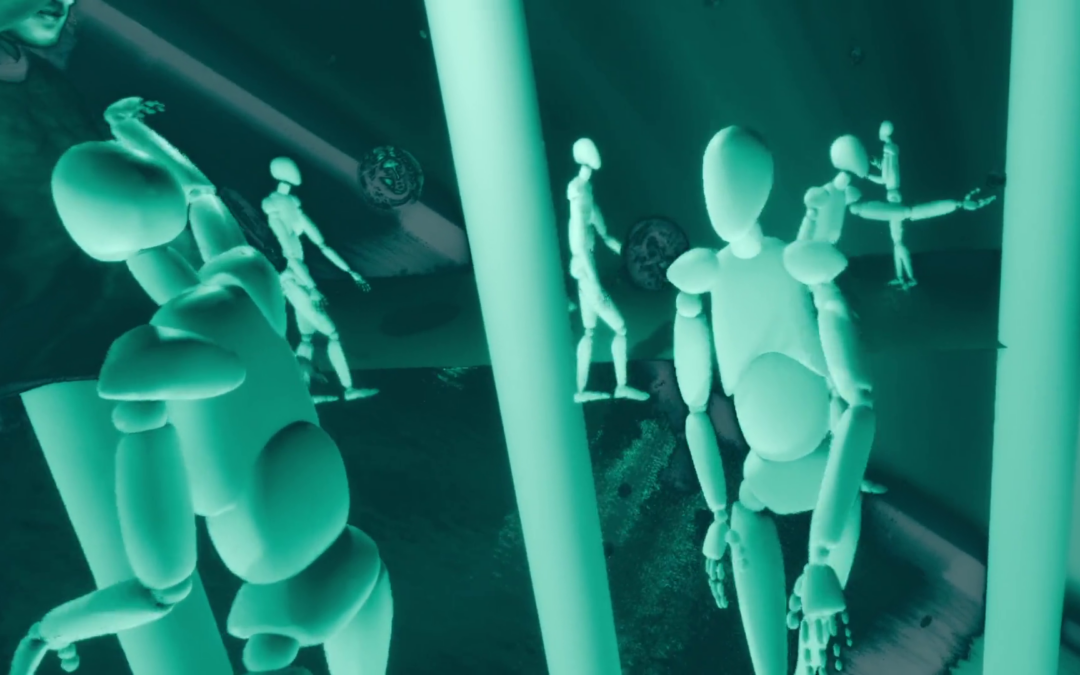
We developed tools that allowed a performer to record fragments of movement, leave them behind as animated avatars, slow them down or take over another avatar and continue performing through it. At certain moments there could be six to ten figures moving around, and the audience couldn't tell which one was the live performer and which ones were recordings.
What became interesting was how the performer started using these possibilities. Initially, everything was carefully scripted, but as the tools became more familiar, the performer began improvising with them. It became a bit like using the body as a musical sampler, composing with recorded movements while continuing to perform live.
- How do you plan to enlarge this approach to a more general audience?
Until now we've mostly tried distributed embodiment with professional performers and audiences who are already quite familiar with XR. That's useful for experimenting, but the general public will probably approach these experiences very differently.
I'm currently focusing on screen-based installations as a next step. For example, a large wall display combined with markerless motion capture, where visitors can walk in and immediately start interacting with virtual bodies. No headset, no controllers, nothing to put on. Apart from being more accessible, it's also a more forgiving medium. In VR, losing control of your virtual body can be quite disorienting, whereas on a screen you can push these experiments with less discomfort.
I'm interested in what happens when people who have no experience as performers start discovering these possibilities themselves. Rather than watching someone else manipulate multiple bodies, they can experiment with what it feels like to multiply themselves or lose control of their own representation.
- What will you do next? Does the many-to-one setup enable interesting social projects? Are you thinking about inclusion?
The many-to-one setup is particularly interesting to me because it immediately introduces a social dimension. If several people control the same body, they have to deal with each other's intentions. They might cooperate, but they can also get in each other's way. And unlike conventional multiplayer experiences, where everybody has their own avatar, here the conflict happens within the same body.
I wouldn't automatically call this inclusive, though. Sharing a body doesn't necessarily mean sharing power equally. Someone might dominate the interaction while another person barely has any influence. I think these situations could be very interesting to explore, including the uncomfortable ones.
I'd also like to investigate how these experiences change when the virtual bodies are no longer neutral. Gender, physical differences and cultural identity can all influence how someone relates to a body, particularly when that body is shared with These are questions I'm starting to address in my follow-up research, where I want to move beyond the technical possibilities of shared embodiment and investigate its social implications more directly.